A Proprietary Framework for Purposeful Alignment and Sustainable Impact
The Cornerstone Concept® anchors my work with individuals, leaders, and organizations.
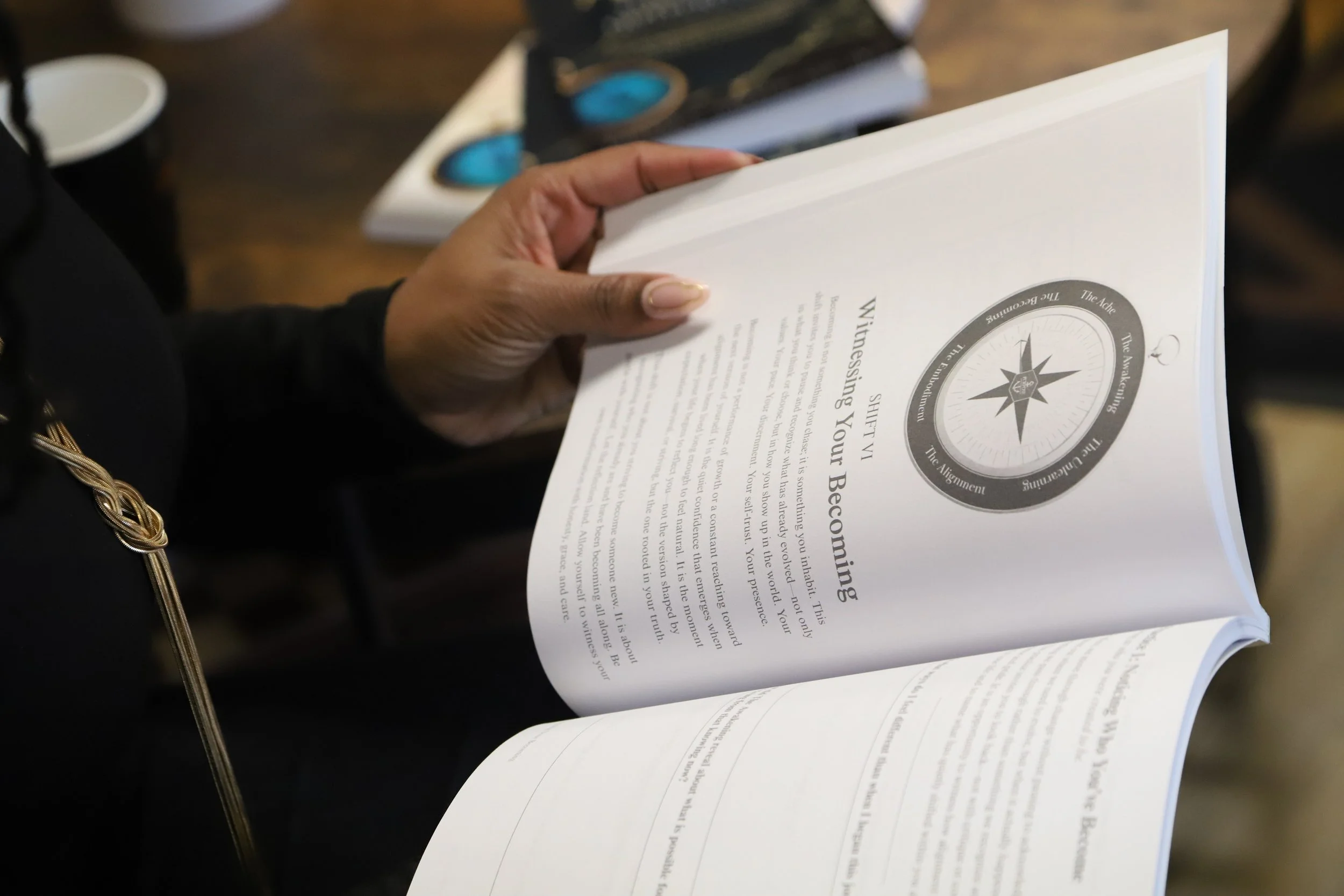
Built on the understanding that the outcomes we experience are often shaped by conditions beneath the surface, the framework creates a way to examine what is misaligned, understand what is driving it, and intentionally create the conditions for something different to become possible. At its core are six interconnected shifts.
One underlying concept. Two distinct applications—for individuals and for organizations.
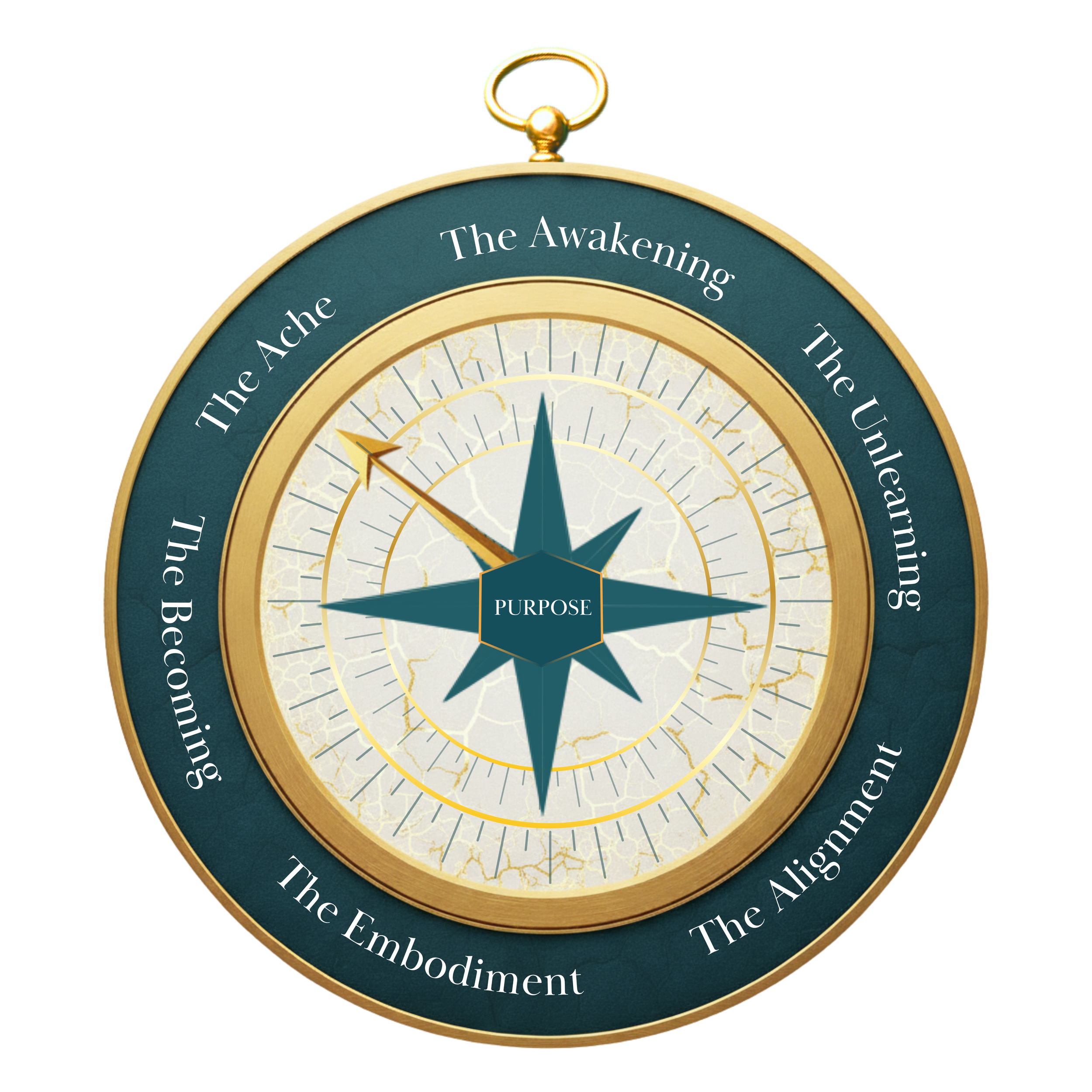
The Cornerstone Concept®
Ache
⎈
Awakening
⎈
Unlearning
⎈
Alignment
⎈
Embodiment
⎈
Becoming
⎈
Ache ⎈ Awakening ⎈ Unlearning ⎈ Alignment ⎈ Embodiment ⎈ Becoming ⎈
The Cornerstone
Concept
®
Two Applications.
One Concept.
The six shifts of the Cornerstone Framework™ remain consistent.
What changes is the container at which we examine them.
For Individuals & Leaders
The Cornerstone Compass™
Purposeful alignment across life, leadership & impact
The Cornerstone Compass™ helps high-achieving individuals and leaders look beyond accomplishment alone and examine whether the life they are building and the way they are leading are aligned with what matters most.
Across the six shifts, individuals explore the beliefs, patterns, expectations, priorities, and ways of operating that shape their choices and experiences—and intentionally create greater alignment across life, leadership, and impact.
THE CENTRAL QUESTION
“Is the way I am living and leading aligned with who I am, what matters to me, and who I am becoming?”

For Organizations
The Cornerstone Alignment Model™
Organizational alignment for sustainable impact
The Cornerstone Alignment Model™ brings the same underlying six-shift architecture to the organizational level.
Rather than treating challenges as isolated problems to solve, the model examines the conditions producing them—including people, leadership, purpose, priorities, culture, strategy, structures, and systems—and identifies where greater alignment is needed to create the organization’s intended impact.
THE CENTRAL QUESTION
“Are the conditions within our organization aligned with the impact we are trying to make?”
How the Framework Translates Across Levels
The same six shifts can surface differently depending on the level at which we are working. What may appear as a question of belief, identity, priority, or behavior within an individual may emerge as a question of leadership, culture, strategy, structure, or systems within an organization.
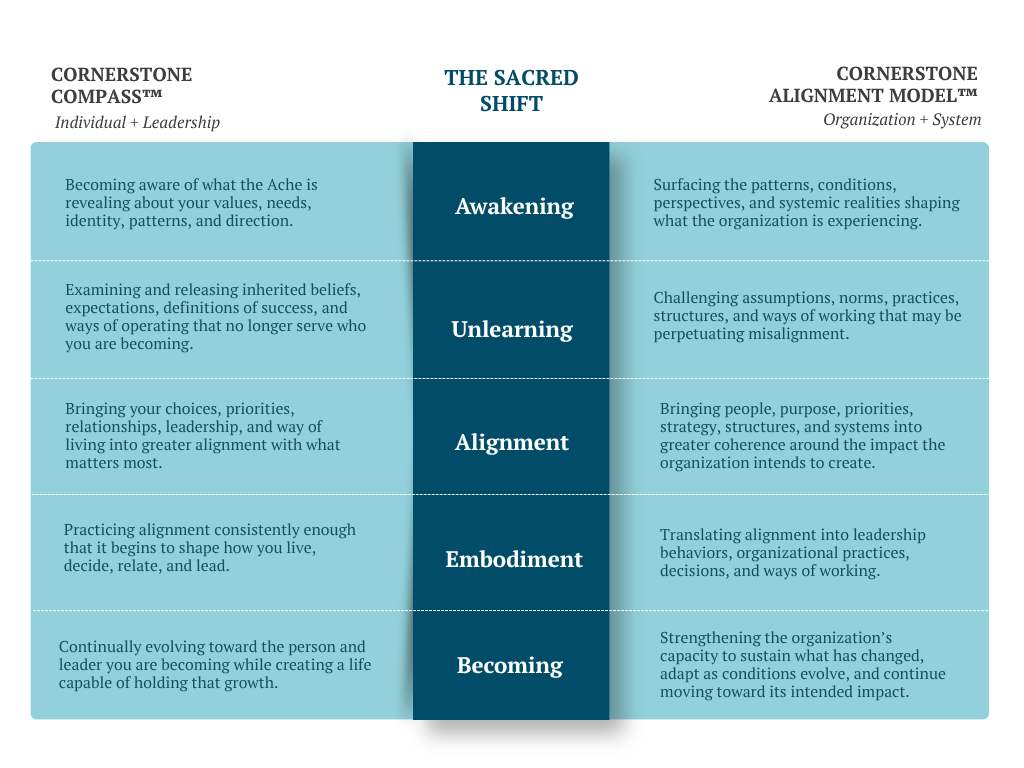
The shifts are interconnected rather than strictly sequential. Depending on the context, individuals and organizations may enter the work through different shifts, revisit them, or experience several at once.
From Framework to Practice
The Cornerstone Concept™ is not a prescribed sequence or a one-size-fits-all process. It gives us an architecture for inquiry, sensemaking, and intentional change.
Where we begin depends on what is happening. We may surface an Ache that has been difficult to name, recognize a pattern that requires Unlearning, uncover an area of misalignment, or focus on what is needed to more fully embody and sustain a desired way of operating.
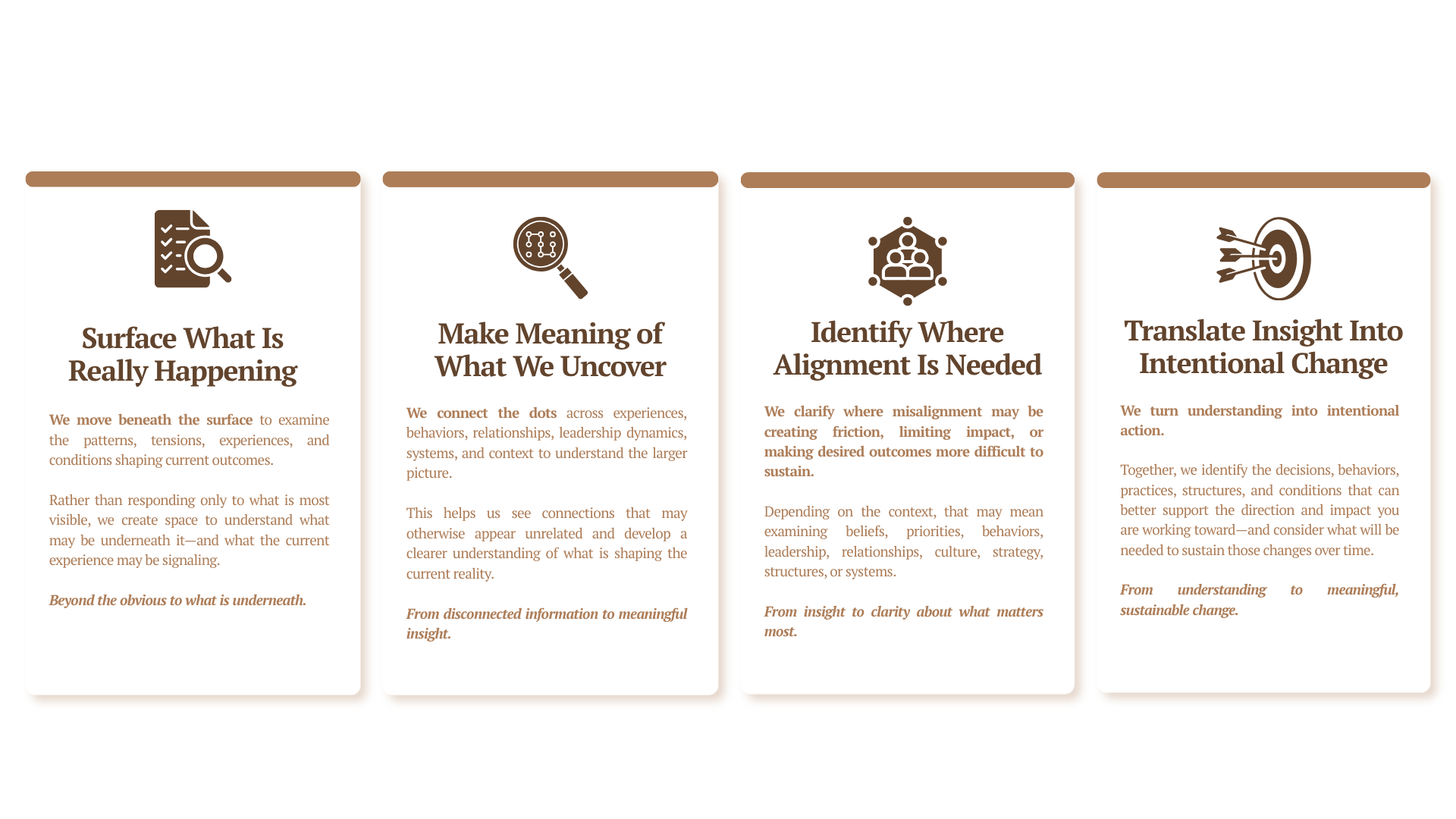
Together, we move beyond the presenting challenge to understand what is shaping it, where alignment is being disrupted, and what conditions need to shift for meaningful and sustainable change to take hold.
Where This Work Takes Shape
The way I engage the Cornerstone Concept™ is shaped by the context, the question in front of us, and what the work requires.
My practice draws on research, organizational strategy, applied inquiry, leadership development, facilitation, and thought partnership. Across these areas, I work to understand what is happening beneath the surface, make sense of complex conditions, and help individuals and organizations translate insight into more intentional action and sustainable impact.
-
I use rigorous inquiry to understand complex questions, surface patterns, and develop insights that can inform strategy, practice, and decision-making.
Examples of methodologies:
qualitative and mixed-methods research
organizational inquiry
case study research, research design
thematic analysis, scholarly writing
translating research into actionable insight, etc.
-
I design evaluation and learning processes that help organizations understand not only whether an initiative is producing intended outcomes, but how, why, for whom, and under what conditions those outcomes are occurring.
-
I help leaders examine the relationships between people, priorities, practices, structures, and systems to understand what may be enabling—or constraining—the change they are trying to create.
This is where things like organizational effectiveness, systems change, alignment work, implementation strategy, culture, and change efforts can live.
-
I design and facilitate processes that bring multiple perspectives into the work, strengthen understanding across stakeholder groups, and inform decisions, programs, strategies, and policies.
This includes:
community listening
stakeholder inquiry
cross-sector collaboration
policy review, design, and implementation
strategic engagement
-
I work alongside leaders to deepen self-awareness, strengthen leadership capacity, navigate complexity, and make more intentional decisions about how they lead, relate, and create impact.
-
I design learning experiences that help people move beyond information toward reflection, application, dialogue, and meaningful change in practice.
This includes:
Interactive professional development sessions
Community listening sessions
Small group retreats
Supporting Models, Assessments & Methodologies
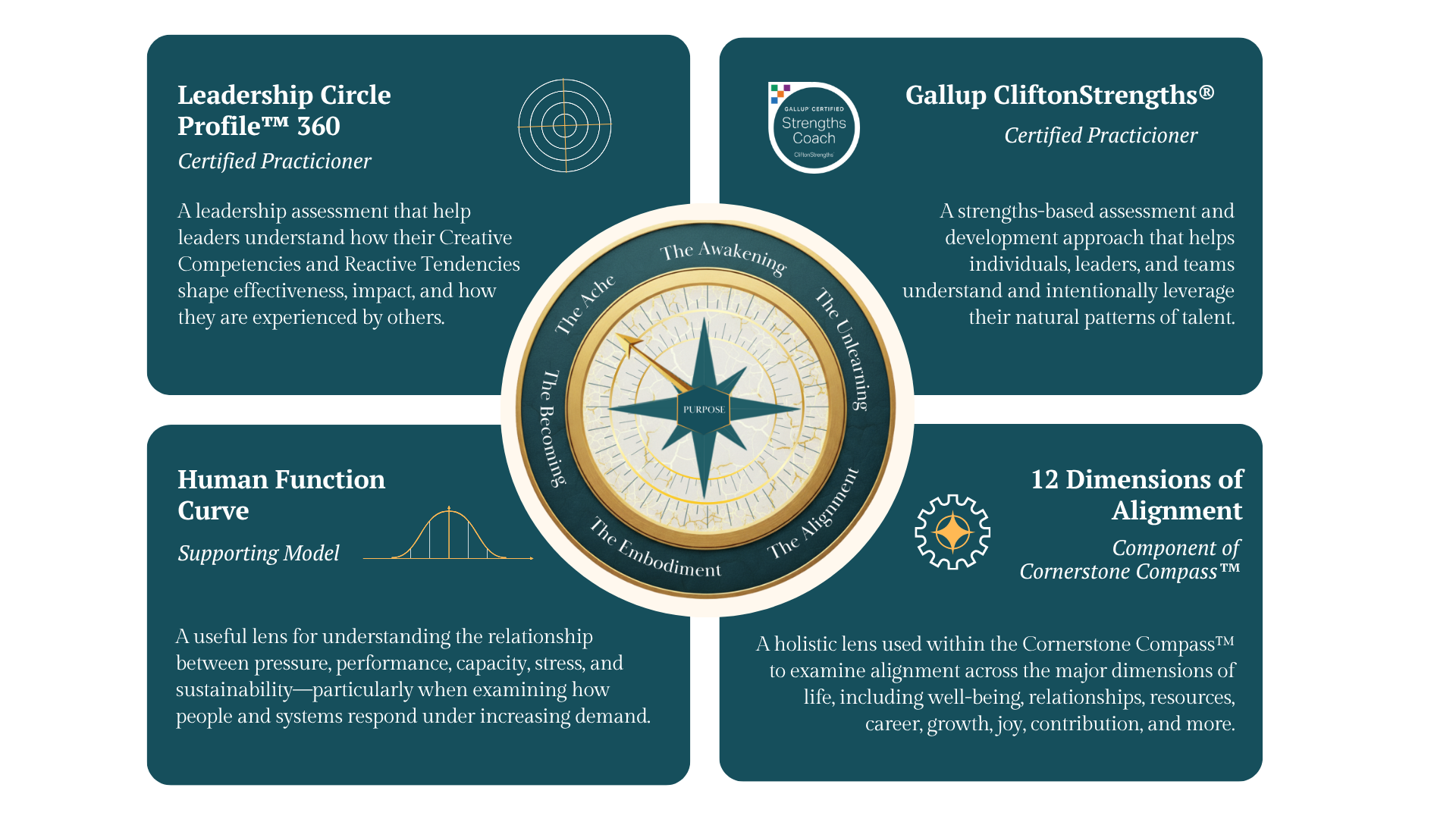
The Cornerstone Concept™ provides the primary architecture for my work. Depending on the context,
I also draw on validated assessments, established models, and complementary methodologies that deepen insight, support reflection, and strengthen decision-making.
These tools do not replace the Cornerstone Concept™. They are selectively integrated when they add meaningful value to the work.